Search for a way to set your fantasy draft order and you get a pile of words that sound different but promise the same thing: randomizer, simulator, generator, wheel, name picker. If you are trying to figure out which one your league should actually use, the labels do not help much. Under the hood, most of them are doing the same job, and the real question is not what a tool calls itself. It is whether it is fair and whether your league will believe it.
Here is what each term really means, and how to choose.
Draft order randomizer
A randomizer takes your list of managers and shuffles it into a random order. That is it. Add the names, hit go, get an order. It is the most honest description of what almost every one of these tools is doing behind the scenes, because a fair draft order is a random draft order.
The strength is simplicity and fairness. A true random shuffle gives every manager the same odds at every slot. The weakness, with a plain randomizer, is that the result appears instantly with nothing to watch and nothing to share. It works, but it does not give the league a moment.
Draft order simulator
"Simulator" usually means a randomizer with a show on top. Instead of just printing an order, it plays out an event, a race, a game, a bracket, and the outcome of that event becomes your order. A 100 yard dash simulator sends everyone sprinting and the finish line decides it. A bracket simulator runs matchups.
The important thing to understand: a good simulator is still random underneath. The simulation is the entertainment, not the decision. That is exactly what you want. You get the fun of watching it happen and the fairness of a clean random draw at the same time. The only bad version is one where the "simulation" is secretly weighted, which is why proof matters (more on that below).
Draft order wheel and name pickers
A wheel spinner or random name picker is the barest version. You drop in names, spin, and it lands on one. Spin again for the next slot, and so on. It is quick and most people already picture how it works.
The catch is that a wheel decides one pick at a time and leaves nothing behind. There is no record, no video, and the person spinning could quietly re-spin a result they did not like. For a casual league that trusts each other, that is fine. For a competitive one with money or pride on the line, "just trust the guy who spun it" is where arguments start.
So which should you use?
Stop sorting by the label and sort by two questions instead:
- Does every manager have an equal shot at every pick?
- Can anyone prove the result was not rigged?
A randomizer, a simulator, and a wheel can all pass the first test if they use a real random draw. Most fall down on the second. A tool that runs the draw in one person's browser and shows a result cannot prove it was not re-run until someone liked it. That doubt is small, but it lasts all season.
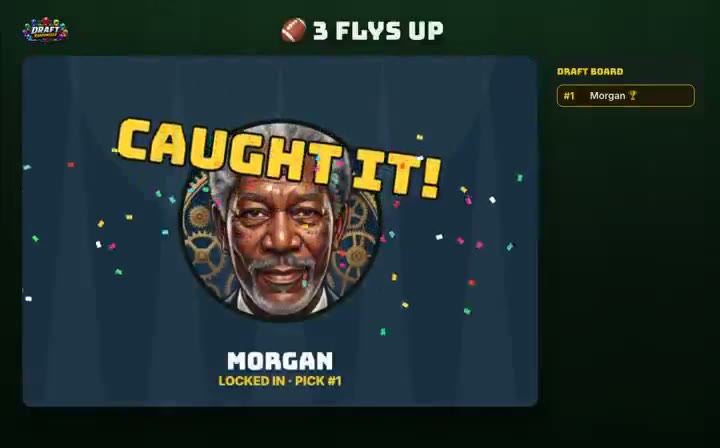
The version that clears both bars is a randomizer with a simulation on top that also publishes its fairness and records the result. Draft Randomizer is all three labels in one: it randomizes the order, plays it out as an on-field game (including the classic 100 yard dash), and hands you a shareable video of the result. It also publishes a 10,000-draft fairness audit so you are not taking anyone's word for it. If you came in comparing it to the old classic, the 100 Yard Rush alternative page breaks down the differences.
The thing all three have to get right
Whatever you call it, the method sets the tone for your whole season. Get it right and nobody thinks about it again. Get it wrong, or leave it unprovable, and one manager spends September convinced they were robbed before a single player came off the board.
That is why the recording matters as much as the randomness. A result the whole league watches at the same moment, spoiler-free, cannot be quietly redone. A number typed into a chat by one person can. Fair odds plus a shared, provable reveal is the combination that actually ends the argument. The label on the button is just marketing.
FAQ
What is the difference between a draft order randomizer and a simulator? A randomizer shuffles your managers into a random order and shows the result. A simulator does the same random draw but plays it out as an event, like a race or a bracket, so the outcome doubles as entertainment. A good simulator is still random underneath; the simulation is the show, not the decision.
Is a draft order wheel fair? It can be, if the spin is truly random and the whole league watches it. The weakness is that a wheel decides one pick at a time and leaves no record, so the person spinning could re-spin a result off-screen. For competitive leagues, a method that publishes proof and records the result is safer.
Which is the most trustworthy way to set a fantasy draft order? A method that gives every manager equal odds and can prove the result was not rigged. The strongest versions publish a fairness audit and reveal the order in a video the whole league watches together, so there is nothing to take on faith.
Is Draft Randomizer a randomizer or a simulator? Both. It randomly sets the order, then plays it out as an on-field game such as a 100 yard dash, and records a shareable video. It also publishes a 10,000-draft fairness audit, so it covers the randomizer, simulator, and generator use all in one free tool.
Do these tools work with ESPN, Sleeper, and Yahoo? Yes. They just decide the order. Once you have it, you enter it manually in ESPN, Sleeper, Yahoo, or any other platform. No integration or login is needed.
Skip the label debate and settle it with a fair, provable draw the whole league can watch. Run yours free at draftrandomizer.com.