Somebody always groans when they draw pick 7 in a 12-team league. No first-rounder they love, no early wrap-around, just a slot in the middle where the best players are already gone by the time it comes back around. That groan is half right and half myth.
Draft position matters. It also matters less than the guy sweating his slot in the group chat thinks. Both things are true, and understanding the gap between them is what separates managers who win from their draft and managers who blame it in November.
The honest answer
Yes, draft position matters, but the edge is smaller than draft-night anxiety makes it feel. Your slot decides which players are on the board when your turn comes. It does not decide whether you draft well.
Here is the part people skip. The value gap between the first overall pick and the last pick in round one is real, but it shrinks fast. By the third and fourth rounds, the player pool has flattened into clumps of similar production, and your ability to read those clumps matters more than where you sit. A great manager at pick 10 beats a passive manager at pick 1 most seasons. The slot is a starting hand, not the whole game.
So the useful question is not "did I get a good pick." It is "did I get a fair pick, and did I play it well." Hold that thought, because the fairness half is where most leagues actually go wrong.
The case for early picks
Pick 1 gets the best player in the world. In a year with a clear top running back or a generational skill guy, that is a genuine advantage. You lock in the safest, highest-ceiling asset before anyone else touches the board, and you never spend a second wondering if you reached.
Early picks also let you build around a cornerstone. When you own the 1.01, you know your anchor and can draft everything else in relation to it. That clarity is worth something, especially for managers who freeze up when the board gets chaotic.
The catch: early picks pay for that top player with a long wait. If you draft first in a 12-team snake, you do not pick again until 24th overall. Twenty-two players come off the board while you sit. Those wraps are brutal when a positional run empties out a tier before your turn comes back. Pick 1 gives you the best single player and the worst wait.
The case for middle and late picks in a snake
Snake drafts flip the order every round, and that structure quietly rewards the slots people complain about.
Middle picks get the fastest wrap-around. If you draft at pick 6 in a 12-team league, your gaps between selections stay short and even all draft long. You pick 6th, then 19th, then 30th, never waiting the full 22 picks that pick 1 waits, and never scrambling at the very back either. You get a steady rhythm and a fresh read on the board every few minutes. In a draft where tiers empty out in bunches, short gaps let you react.
Late picks get the back-to-back. Draft 12th in a 12-team league and you grab the 12th and 13th overall players in one breath. That is a mini two-for-one at the turn, and it repeats every round. You can pair two players from the same tier, or grab a falling stud and pivot to need on the very next pick. Managers who love the turn will tell you it is the best seat at the table, because you are never left watching your target get sniped between your picks. You control both ends of the wrap.
None of these slots is strictly better. Pick 1 trades wait time for the top player. The turn trades the top player for paired picks and control. The middle trades both extremes for consistency. They are different hands, not better and worse ones.
How tiers flatten the difference
Here is the concept that makes all of this make sense: tiers.
Players are not a smooth ranking from 1 to 200. They come in clumps. A handful of elite running backs, then a drop-off. A cluster of similar wide receivers, then another drop. Sharp managers draft the tier, not the rank. If five receivers are basically interchangeable, it does not matter whether you get the 3rd or the 5th of them. They will score about the same.
That is why draft slot matters most at the very top, where the tiers are thin, and matters less as you go, where the tiers are wide. When a tier holds ten similar players, your pick position inside that stretch is close to meaningless. You are picking a name, not a big edge. The gap between slots is real in round one and mostly noise by round five.
Read the tiers well and any slot can build a strong roster. Ignore the tiers and no slot will save you. That is the whole ballgame, and it is why obsessing over your number misses the point.
Why fairness in assigning the slot matters more than the slot itself
Sit with the trade-offs above and a bigger truth shows up. Since every slot carries real advantages and real costs, the one thing that must be square is how the slots get handed out.
If pick 1 gets the top player and the turn gets the back-to-back, then every manager should have an equal shot at every slot. Not the returning champ getting first dibs. Not the commissioner's buddy sliding into the turn. Not a "wheel" nobody actually watched spin. When the assignment is lopsided or even just unverified, the whole draft starts under a cloud, and someone spends the season convinced they were robbed before a single pick was made.
This is the part leagues get backward. They argue for an hour about whether pick 5 is any good, then assign it with a method nobody trusts. The slot debate is mostly noise. The assignment method is the thing that actually decides whether your league feels fair.
Fair means two things at once. Equal odds, so every manager truly has the same chance at pick 1 as everyone else. And no rigging, so the person running the league cannot quietly tilt the result, even by accident. A method that delivers both takes the entire draft-slot argument off the table before it starts.
How to make it fair and transparent
The fix is a method that is random, provably fair, and out in the open where everyone can see it.
Random handles equal odds. A true random draw gives every manager the same shot at every slot, which is exactly what the trade-offs above demand. Provably fair handles trust. It is one thing to say a method is square and another to show the receipts. Draft Randomizer publishes a 10,000-draft fairness audit that shows every manager has an equal chance at every pick and the commissioner cannot rig the result. That is the difference between "trust me" and "here is the proof."
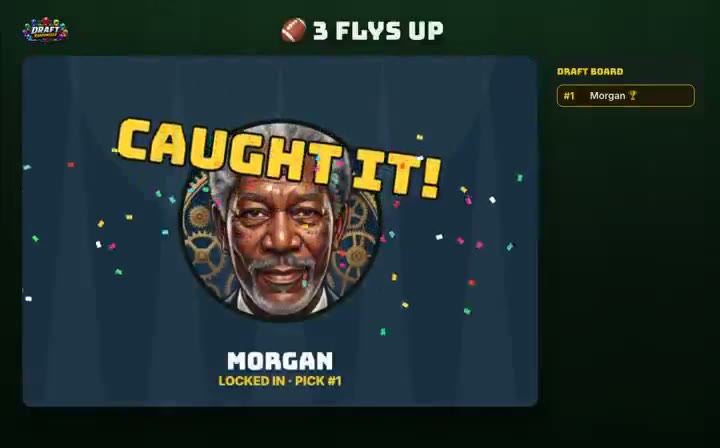
Transparent handles the human part. The order should be revealed in a way the whole league watches together, not typed into a spreadsheet by one person nobody can check. Draft Randomizer records a shareable, spoiler-free video of the order being decided, so you send it to the group chat and everyone finds out at the same moment. No back-room draw, no "just take my word for it." You can see how it works start to finish.
It is free with no sign-up. There is a one-time Pro unlock at $4.99 if you want the extras, but the fair, shareable draw costs nothing. For a decision that sets the tone for your entire season, that is the right amount of friction: none.
FAQ
Does the first pick win fantasy leagues more often? The top slot has a small edge in some seasons, mostly when there is a clear best player at the top of the board. But that edge fades fast after round one, and draft skill, in-season management, and the waiver wire swing far more games than pick position does. First overall helps. It does not decide anything.
Is the middle or the end better in a snake draft? Neither is strictly better. Middle picks get short, even gaps between selections, which lets you react as tiers empty out. End picks get back-to-back selections at the turn, which lets you pair players and control both ends of the wrap. Pick the strengths that fit how you like to draft, because the raw talent difference between them is minor.
How much does draft position actually matter? It matters most at the very top, where the best-player tiers are thin, and less as the draft goes on, where tiers get wide and players clump into similar groups. Reading those tiers well matters more than your slot number. A good manager beats a bad slot; a bad manager wastes a good one.
What is the fairest way to assign draft order? A truly random draw where every manager has an equal shot at every slot and nobody, including the commissioner, can rig the result. The best versions are provably fair (with a published audit) and transparent (revealed in a way the whole league can watch), so no one starts the season feeling cheated.
Is it better to draft first or last in fantasy football? Neither wins outright. Drafting first gets you the single best player but a long wait until your next pick. Drafting last (the turn) gets you back-to-back picks that let you pair two strong players and control the wrap. Pick 1 is a slight edge in a year with one clear top player; otherwise the turn is just as good.
What is the best draft position in a 12-team league? There is no single best slot. Picks 1 through 3 lock in an elite player, while picks 10 through 12 get quick back-to-back selections at every turn. Studies of full seasons show the win-rate gap between slots is small, so draft skill and in-season moves matter more than which number you draw.
Stop arguing about who deserves pick 1 and let a fair, random draw settle it in a video the whole league can watch. Spin your order free at draftrandomizer.com.